The recruiting side

One intake call. The whole search follows.

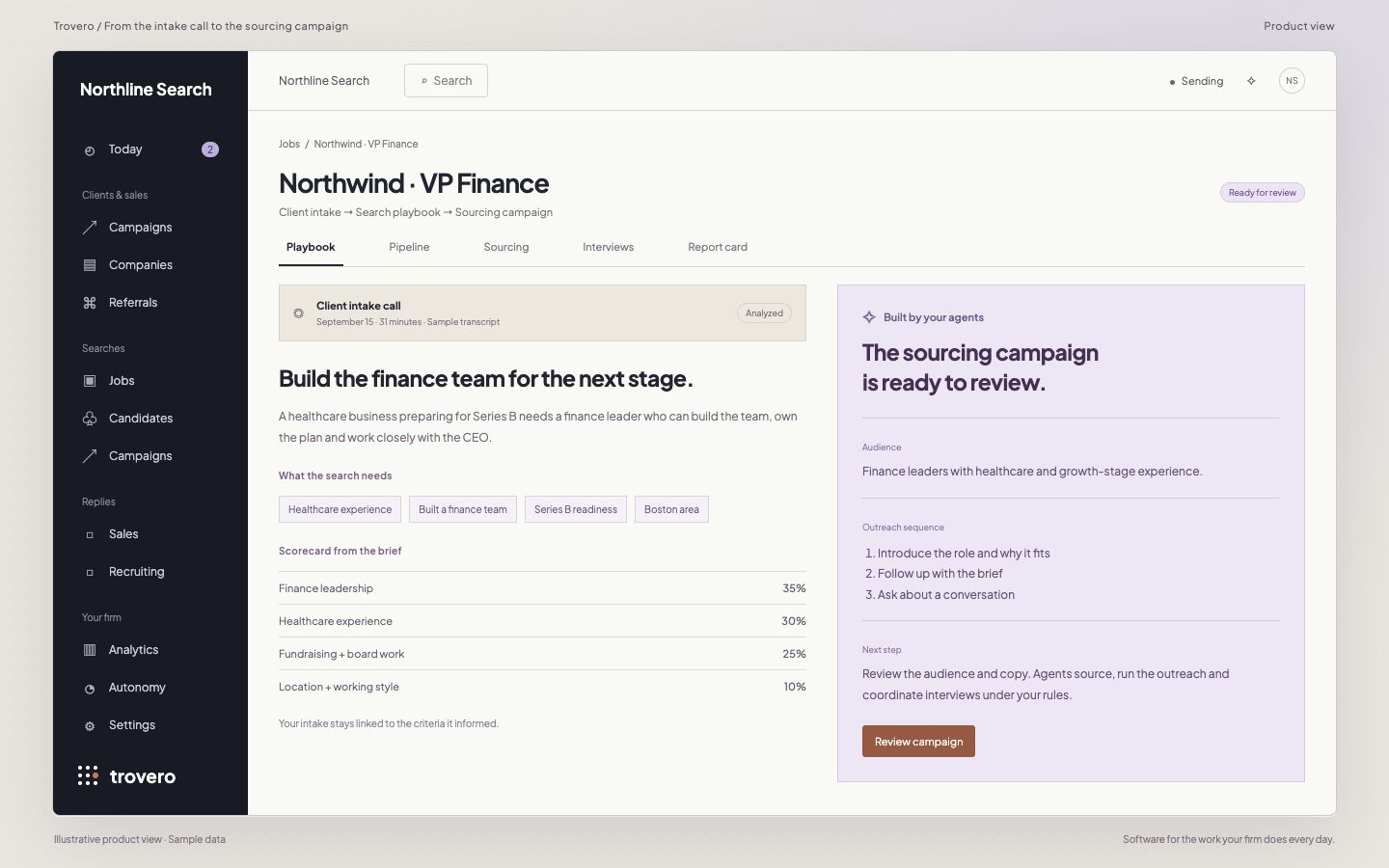
Your intake call becomes the playbook, built the way a senior strategist would build it. The playbook becomes the sourcing campaign. The campaign fills your pipeline in your voice, on every channel that matters, while the evaluation stays rigorous and human.

Sends live GB

Playbook

Compiled from one intake call — every artifact waits on your approval

20 / 20 saved Complete
Preview Client View Generate Sourcing Campaign
Overview artifacts2 / 2 saved
A1Customized JDCustomerEdit
Scorecard6 / 6 saved
A5Weighted SkillsCustomerEdit
A7Screening FiltersInternalEdit
A8Holistic 4-Band RubricCustomerEdit

Twenty artifacts from one intake call. Customer rows are what your client sees. Internal rows never leave your side.

01

The playbook is the search.

Run the intake like you always have. Paste the transcript, or let a synced meeting deliver it, and the playbook compiles itself: job description, ideal profile, weighted rubric, boolean for your search tools, target companies, interview kits, comp notes. Twenty artifacts, each one editable, each one waiting on your approval. Nothing downstream moves until you sign it.

IntakePlaybookCampaign
02

Approve it, and sourcing is already running.

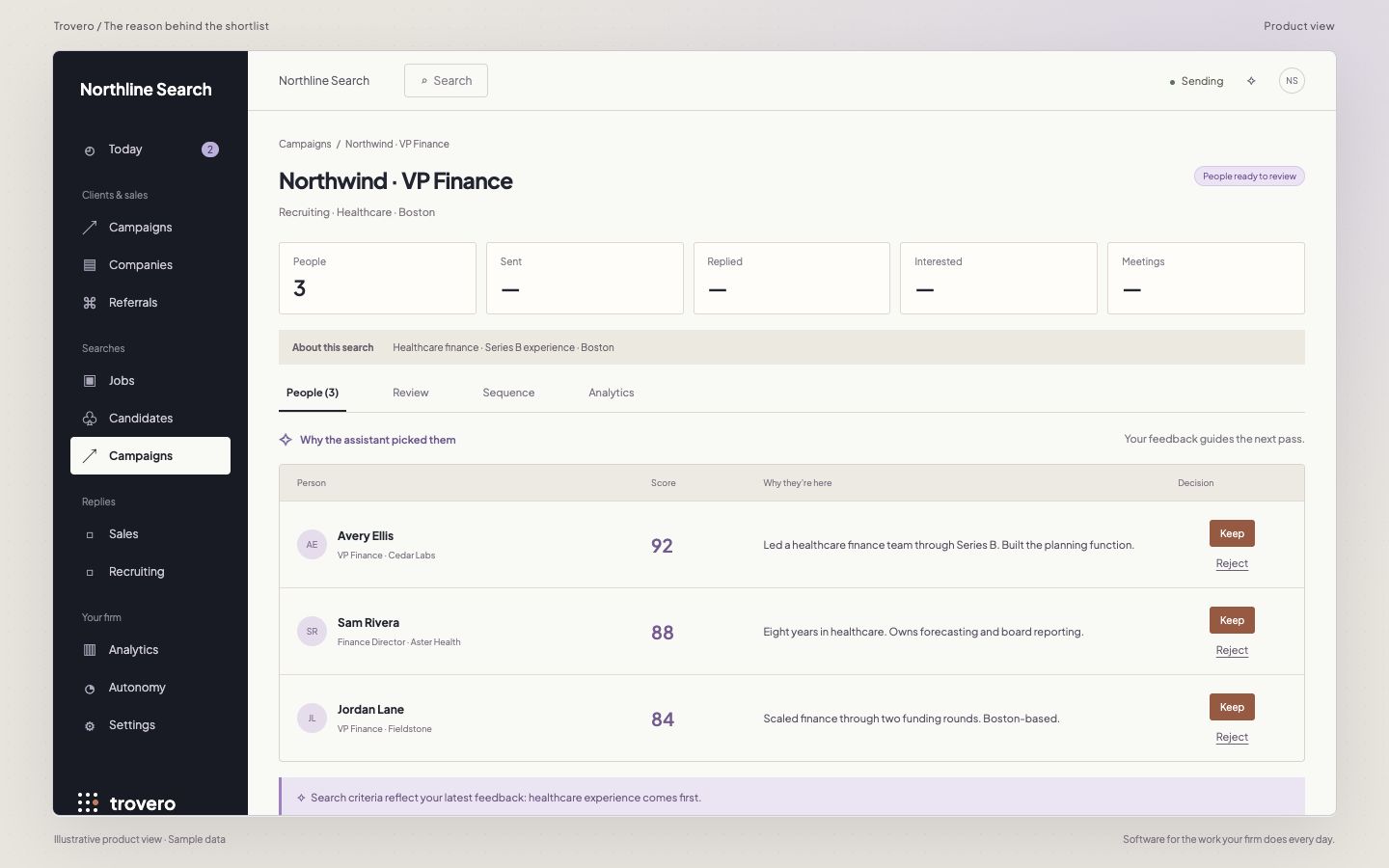
The approved playbook drafts the sourcing campaign itself: criteria from the rubric, a multi-step sequence that sounds like a recruiter, not a robot, and a personalization hook for every candidate. Email goes out on its own once you launch. LinkedIn stays above board: one-click copy, one-click paste, a Chrome extension to pull profiles in as you browse.

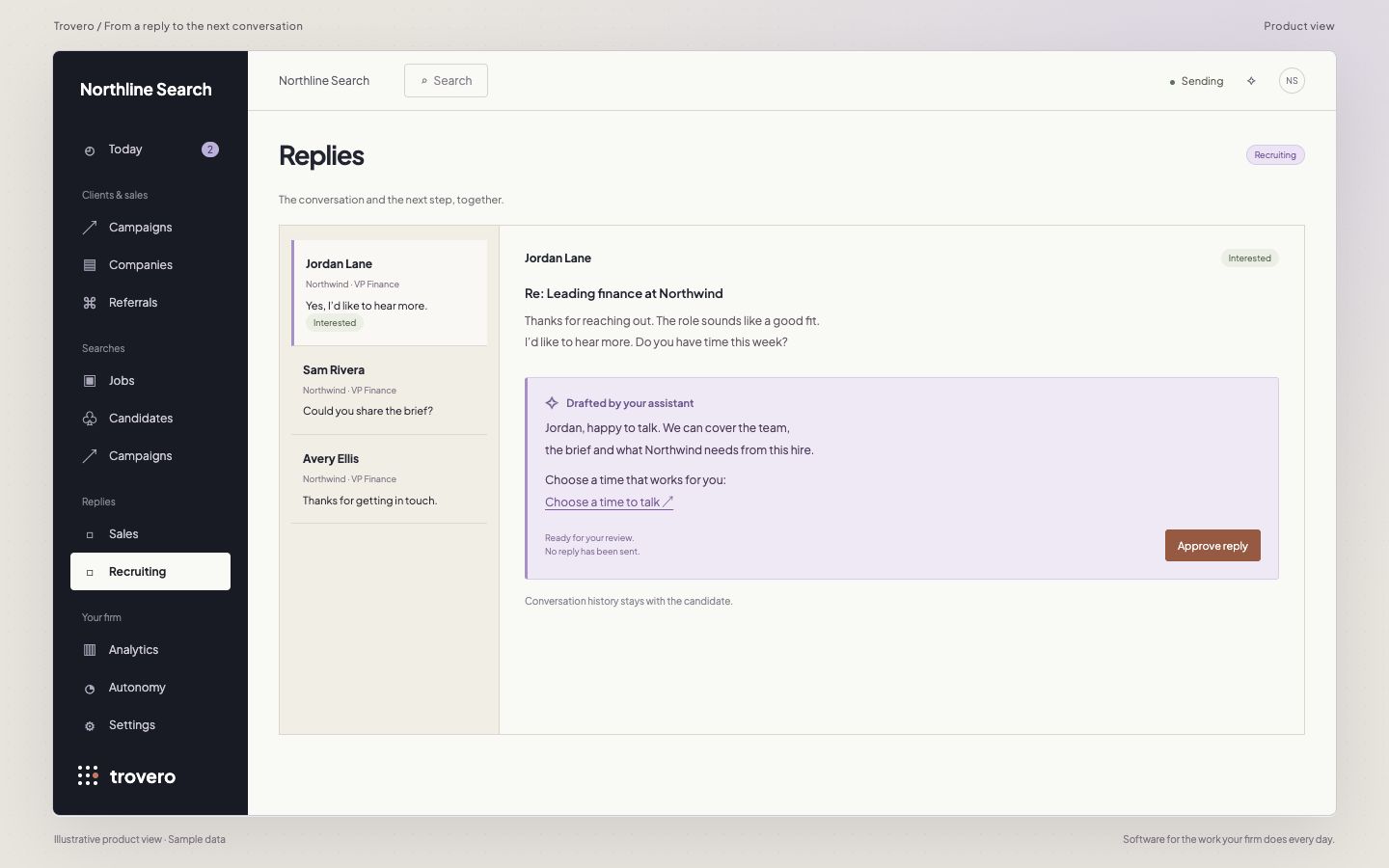
When a candidate replies interested, the digital sourcer sends the booking link and gets them on your calendar. You show up and do the part you are actually great at.

  • Multi-channel sequences: email automated, LinkedIn one-click and compliant, calls queued with context.
  • Every message personalized off a verifiable hook, in your voice, or it does not send.
  • Interested candidates get the booking link without you touching it.
  • Chrome extension: add candidates from LinkedIn as you browse. Works on the sales side too.
03

Your database stops being a graveyard.

Import your existing candidates and the digital sourcer searches them first, before it spends a search on the open market. People you already know, already vetted, already talked to become the first shortlist instead of a forgotten export.

12 Your candidates, searched firstThe open market, after
04

Evaluation your client can hold.

After the screen, upload the transcript and the Evidence Profile comes back built. Every score sits on the rubric your client approved, with quoted evidence from the call behind it. A competency profile, the candidate's own words, and a radar that shows the shape of the person at a glance. It reads like the work of a firm twice your size, and it is yours in minutes.

This system exists because of a blind spot. We were great at hiring for clients and bad at hiring for ourselves, so we took ourselves out of the equation: rubrics, weighted scoring, situational questions, a scorecard instead of a gut call. It worked well enough that our client searches started running on it, and retention climbed on both sides of the offer. Trovero is that process, built in — raw transcript to finished scorecard in minutes, where it used to take us days.

A human makes every decision about every candidate. Trovero does not reject, does not filter, does not decide who is qualified. It makes your judgment legible.

Evidence Profile

A. Whitfield · Director of Clinical Operations

Arbor Health · screen transcript, scored against the rubric the client approved at intake

89 / 100

Strong advance

Clears the meets bar on 12 of 14 axes, both knockouts met, quoted evidence behind every number.

Recommendation. Advance to the panel round. The transcript shows evidenced ownership of clinical operations at multi-site scale, with specific, dated wins in credentialing throughput and regulatory readiness, the two knockouts on this rubric. The axes under the bar, vendor management and crisis response, read as coachable gaps rather than disqualifiers, and the panel should probe incident ownership directly. A recommendation, not a decision. A human makes the call on every candidate.

Competency profile, candidate against the meets bar

Ops leadership Multi-site oversight Regulatory readiness Payer fluency Quality systems Staffing and capacity Budget ownership Systems fluency Data fluency Change management Communication Vendor management Team development Crisis response
A. Whitfield Meets bar, from the approved rubric

Interview highlights, the candidate's own words

"We took credentialing intake from a forty day queue to under three weeks by rebuilding the handoff before we ever asked for headcount."

Ops leadership14:22

"I will not open a clinic on a staffing plan the charge nurses have not signed. I have delayed a launch over it, and I would do it again."

Staffing and capacity31:05

"Incident response sat with our compliance partner. I ran the reviews, but I did not run the room."

Crisis response, gap noted42:40

Ops leadership Knockout: met

Ran three sites and a central credentialing function. Examples specific, dated, checkable.

Regulatory readiness Knockout: met

Named the surveys, the findings and the fixes unprompted. Audit-trail thinking throughout.

Payer fluency

Deep on CAQH and PECOS mechanics. Multi-state Medicaid exposure is one state deep.

Change management

Rebuilt the intake workflow mid-quarter with no service interruption, floor on side.

Vendor management Under the bar

Has inherited vendors. Has not run a selection or an exit. Coachable, worth a probe.

Crisis response Under the bar

Ran the reviews, not the room, and said so plainly. The panel should probe this directly.

05

You smell the smoke before there is a fire.

Every search tracks itself: time between stages, conversion between stages, and a daily health read on every open job. A search that is quietly stalling looks exactly like a search that is fine, right up until the client asks. Not here. Here it flags the drift while it is still a nudge, not an apology.

Built for teams.

Solo recruiters run the whole loop alone. Firms split it: recruiters and coordinators work the same pipeline, the same playbooks, the same queue, with every action attributed to the person who took it. The more desks, the merrier. The price does not care.

See it run a live search

Gregg runs the walkthrough, on the live system that runs his own firm, on real work from that morning. Forty-five minutes. Ask the questions vendors flinch at. You leave with a straight answer on whether this fits your firm, and no is one of the answers.

If you pass, nothing happens. No sequence. No follow-ups. You are not on a list.